Power
Swaps, PPAs and fixed physical deals on hourly and sub-hourly curves.
Open source ETRM · Power · Gas · LNG · Crude
Open source trading, risk and physical operations in one system. Run it yourself, or have us install and support it.
Apache 2.0 license · Standard PostgreSQL · Yours to run
In active development: a foundation, not yet qualified for production use. See what works today.
Swaps, PPAs and fixed physical deals on hourly and sub-hourly curves.
Swaps and physical supply, from nomination to daily cash.
Cargoes with loading and discharge terms, valued before loading.
Physical barrels, from receipt and title transfer to invoice and payment.
For the front office
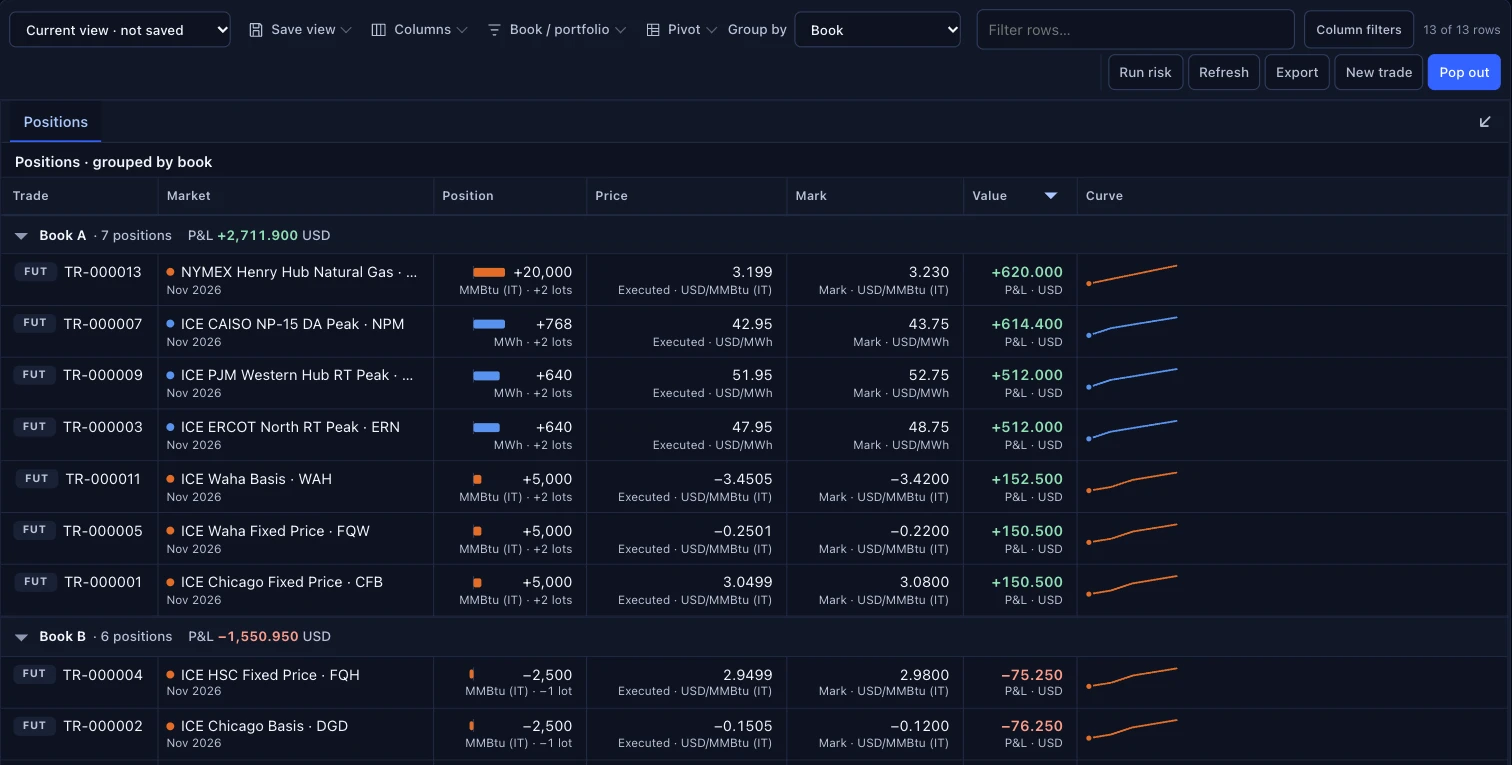
Capture futures, listed options, swaps, PPAs and physical deals in one blotter. Try a trade against the market before it becomes a position.
Preview a swap's payments and discounting, or a future's entry price and open exposure, without creating a position.
Filters, pivots, saved views, charts and exports, with each trade's detail docked beside the grid.
Build forwards, basis and hourly shapes from the prices you choose. A diagram shows which inputs built each price.
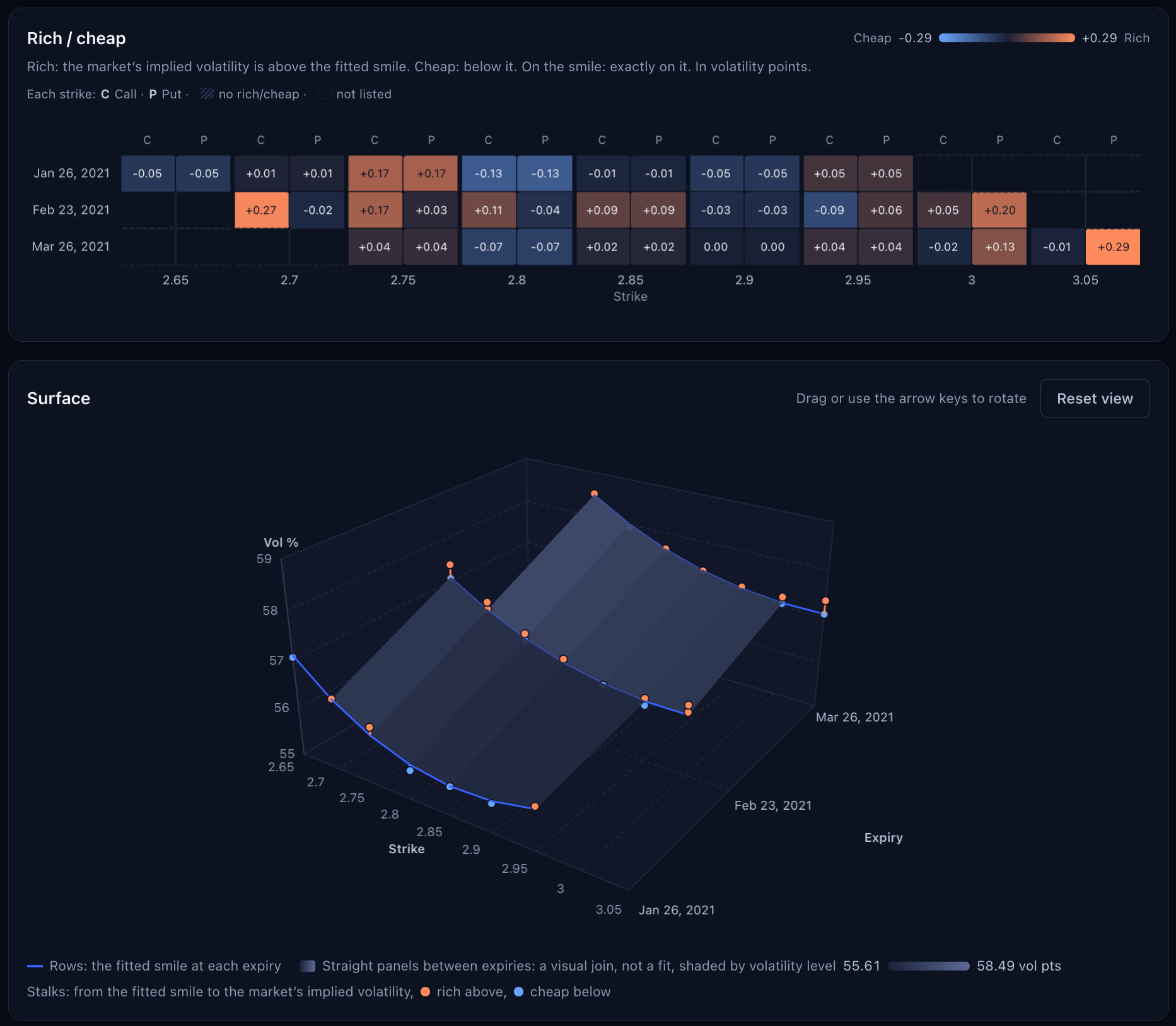
Fitted smiles, rich and cheap heat maps and a 3D surface for listed options on futures.
Three short films
A listed option, from ticket to blotter.
Terms, schedule and price in one pass.
Describe the deal, review the draft, book it yourself.
For risk managers
Exposures come from repricing the book under shared market scenarios, so every position is compared on the same basis.
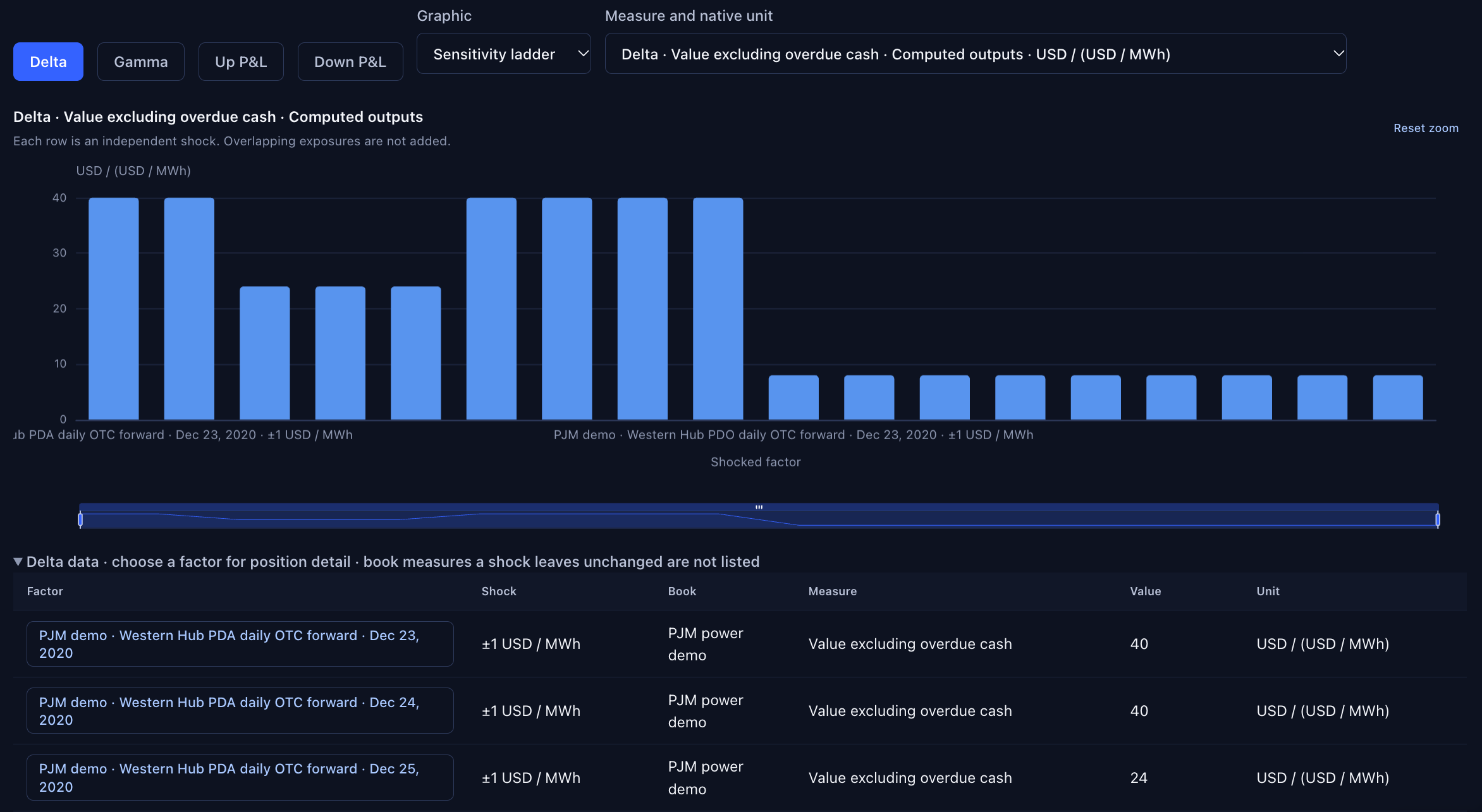
A ladder shows each shocked contract's exposure, by book and by measure.
Parametric, historical simulation, Monte Carlo and a PCA hybrid, each with its diagnostics on screen.
Layer temporary market stresses, then measure risk around the stressed market.
Reopen a past business date at a chosen knowledge time. Corrections add revisions and never overwrite the record.
Three short films
Replay past market moves through today's book.
Correlated shocks, full repricing, visible convergence.
Why a book made or lost money between two dates.
For physical desks
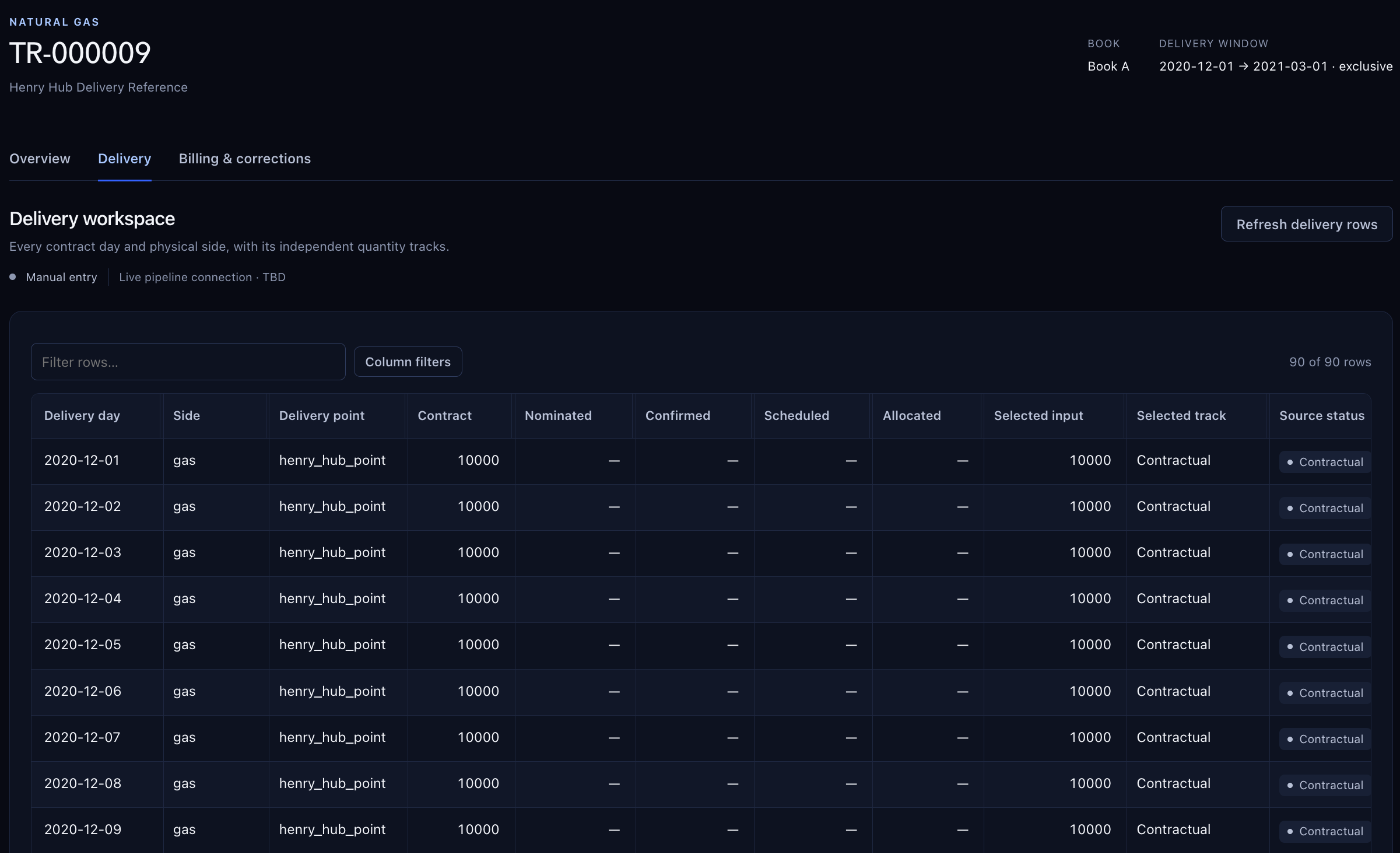
Schedulers and operators work the same trades the desk booked, with quantities kept for every delivery day.
Nominations, acknowledgments, scheduled quantities and imbalances, through to daily cash determinations.
Receipts, title transfer, inventory lots and dispatch, through to invoices and payments.
Cargoes with separate loading and discharge terms, Incoterms and energy conversion, valued before loading.
Fixed physical deals priced on hourly curves, with shaped around-the-clock quantities.
Three short films
Nominate, schedule and reconcile a gas day.
Follow a deal that is already delivering.
Paste a scheduled-quantity report. Approve each step.
AI built in
An AI agent is a user in its own right here, with its own identity, only the access you grant it and the same operations the screens use.
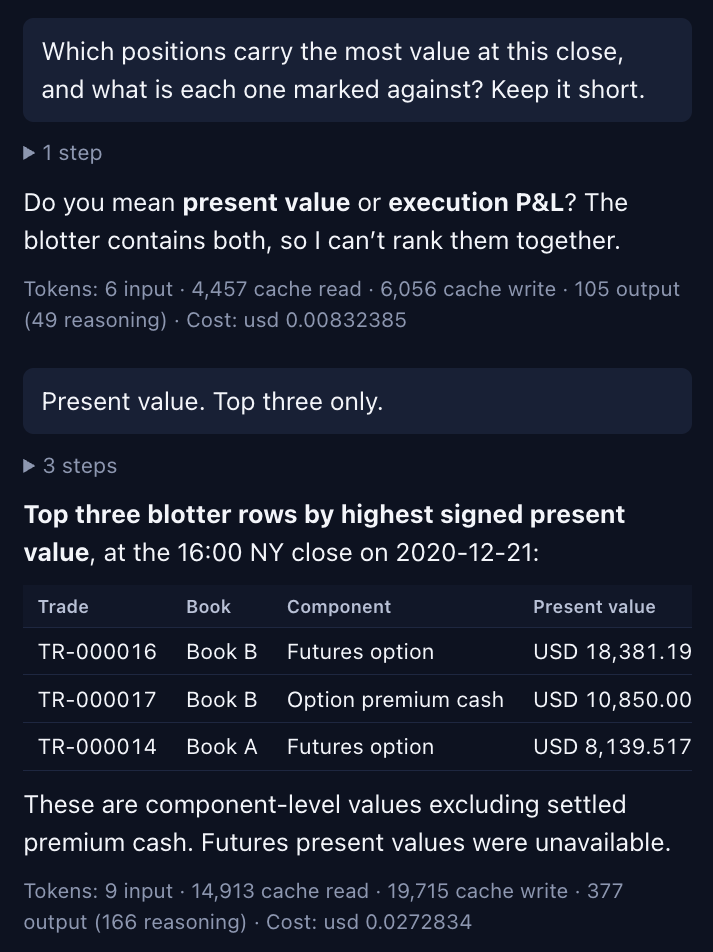
Ask about what is on screen. Each answer is pinned to the market date and knowledge time you are looking at.
The assistant fills tickets, sets up risk runs and prepares curve changes. Nothing is saved until you approve it.
Bring your own keys for Anthropic, OpenAI, Google, xAI or Meta models. Usage and cost are recorded for each one.
The assistant works through a closed list of the application's own operations. It has no SQL, no arbitrary web requests and no code execution.
Security and audit
Controls sit in the database itself, not only in the screens, and every result can be traced to the inputs that produced it.
PostgreSQL row-level security applies each person's roles to every read and write, whichever screen or agent asks.
Editing market data and approving it are separate roles. Managing access is separate from trading.
People, services and AI agents sign in as distinct identities. An agent acts only under a grant a person gave it.
Role changes, agent grants and revocations are written to an append-only audit.
Trades, prices and curves change by new revision. A correction never replaces the record it corrects.
Each valuation keeps the prices, units and model versions behind it, so a number can be explained later.
Installation and support
The software is free under Apache 2.0. Paid installation and support come from Trusty Genius, the team that builds it.
Free · Apache 2.0
By Trusty Genius
Still being built. Futures variation margin, LNG cargo settlement, gas invoicing, VaR backtesting and single sign-on are in progress, and the project is not yet qualified for production use. The repository lists what works today.
Ask for a walkthrough, or open the repository and start a preview on synthetic data.
For a walkthrough, write to joe@trustygenius.com
The hosted pilot is by invitation. Sign in with your invited account.